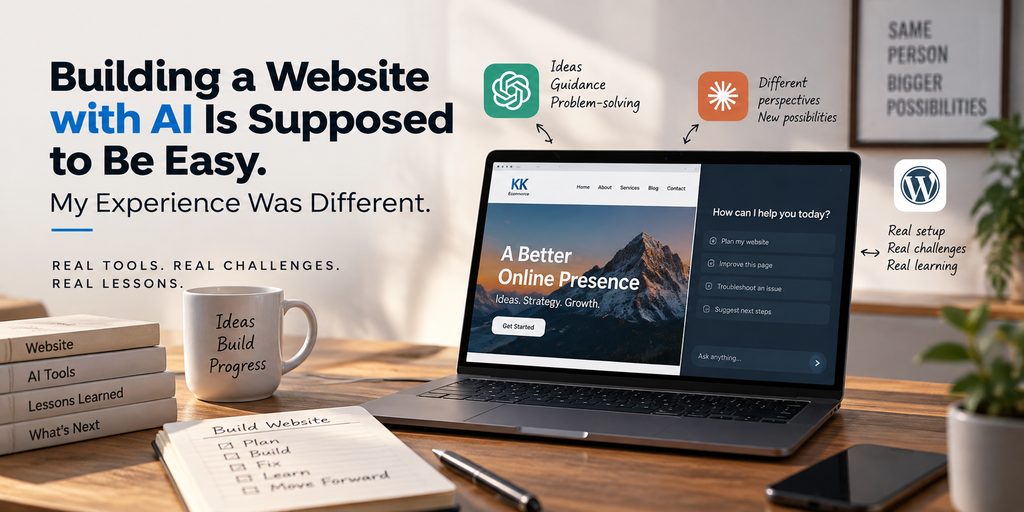
Building a website with AI sounded easy to me at first. Over the past few days, I’ve been rebuilding www.kkecommerce.com with the help of AI, and the experience has turned out very differently from what I expected.
Before I started, my impression was simple: describe what you want, press a button, and a complete website appears. AI can generate a website quickly — but building one that truly represents a real business, a real person and a real story is a different task entirely. Throughout the process, I kept wondering why it still felt so complicated when everyone insists AI has made website building easy.
Why I Moved Away from Wix
KK Ecommerce had been on Wix for years, but the annual cost had become harder to justify given how little we were actually changing. With my growing interest in AI, this felt like the right time to rebuild properly — domain through GoDaddy, hosting with Hostinger, email through Google Workspace, choosing each provider based on where it offered the best fit and value.
I assumed AI would handle most of the process. In reality, it guided me through it, but I still had to make the changes myself, check every screen, and work through problems one at a time. That’s when I started asking a more basic question: if AI is this capable, why can’t I just connect Claude to GoDaddy or Hostinger and let it settle everything on its own? The answer was that AI could help enormously, but it wasn’t yet able to freely enter every system and act the way I’d imagined.
I Ended Up Learning More Than I Expected
Because I still had to work through the setup myself, I picked up things I’d never really paid attention to before — the basics of DNS, nameservers, SSL, MX records, SPF, DKIM, DMARC, WordPress plugins, caching, and MCP (Model Context Protocol). A week earlier, most of these terms would have meant little to me; now I at least understand why they matter.
At one point I asked AI why it hadn’t just pushed me toward the easiest plug-and-play option from the start. The answer, when I thought about it, was that this wasn’t really what I wanted — I wanted control over the site, the ability to keep publishing, room to expand later, and the option to add payments down the road. The easier path might have gotten me a website faster, but not the one I actually wanted.
AI Still Saved Me a Huge Amount of Time
I didn’t start from a blank WordPress install — AI generated the first five pages for me (Home, About, Services, Blog, Contact), which gave me a structure to build on and saved a huge amount of time. But once those pages existed, the real work began: making the wording sound like me, fixing the footer, sorting the Contact page, and shaping the whole site into something that explains who I am and where I’m headed, not just what the company sells.
That’s where one of AI’s real strengths and limits became clear. AI is very good at getting you from nothing to something. Turning that something into something accurate and personal still takes judgement and repeated rounds of improvement.
The Website Forced Me to Rethink My Own Story
While rebuilding the site, I realised I wasn’t only redesigning pages — I was reorganising my own professional story. I had to connect more than 25 years of experience: studying Computer and Communication Engineering at UPM, working with Motorola, Nokia Nigeria and Huawei, then leaving the corporate world for entrepreneurship, KK Ecommerce, marketplace training, cross-border expansion, and now AI.
Fitting those experiences onto a webpage wasn’t the hard part — deciding what they add up to together was. I no longer want KK Ecommerce seen simply as an e-commerce company; I want it to be a place where I share real business experience and rebuild my journey as a speaker and trainer. Rebuilding the website, in other words, forced a harder question than any design choice: what should KK Ecommerce represent today?
Then I Started Asking a Bigger Question
Once the site was taking shape, I began wondering whether AI could do more than advise me — whether, instead of telling me which button to click, it could enter the system and make changes itself. That was closer to what I’d originally pictured: telling it to improve my Contact page, keep the existing style, save it as a draft, and show me what changed. That question is what led me to start experimenting with Claude, Hostinger and MCP.
Claude Could Reach Hostinger, But Not Yet Work Inside Elementor
By early September, I’d connected Claude to my Hostinger environment — already a real step forward. But when we explored whether it could directly edit my actual Elementor pages, we hit another limitation: connecting to the hosting environment is one thing; understanding and editing the website’s structure inside Elementor is another.
I’d started looking at workarounds, and almost began building one. Then I found out Elementor was already preparing something better.
Then I Realised I Might Not Need the Workaround
Elementor’s roadmap for September 2026 includes Elementor MCP, designed to let AI tools like Claude and Codex connect directly to Elementor sites and work with pages and content natively — almost exactly what I’d been trying to build myself.
Rather than spend time on a complicated temporary workaround, I decided to wait for the official implementation. The site is already running, and I can keep improving it by hand while the technology catches up. It’s a useful lesson about AI adoption in general: the field moves so fast that a limitation today may disappear sooner than expected.
So, Is Building a Website with AI Easy?
Yes and no. If the goal is a decent-looking website online quickly, AI makes that remarkably easy. If the goal is a website that properly represents your business, tells your story accurately, and can grow with your plans, there’s still real work involved — the difference is that you no longer have to learn it all alone. That’s probably what I misunderstood at the start: AI doesn’t remove the need to learn; it makes the learning much faster.
The Website Is Still Far from Finished
There are still pages to improve, articles to publish, and plenty of detail left before the site becomes what I want it to be. But looking back at just a few days of progress — off Wix, rebuilt on WordPress with Hostinger, five AI-generated pages reshaped into my own voice, and a much clearer sense of what KK Ecommerce should represent — I’m encouraged.
So for now, I’ll keep improving www.kkecommerce.com and watch what Elementor MCP delivers. Then Part 2 begins — and this time the question isn’t whether AI can help me build a website. It’s whether AI can finally work inside it with me.