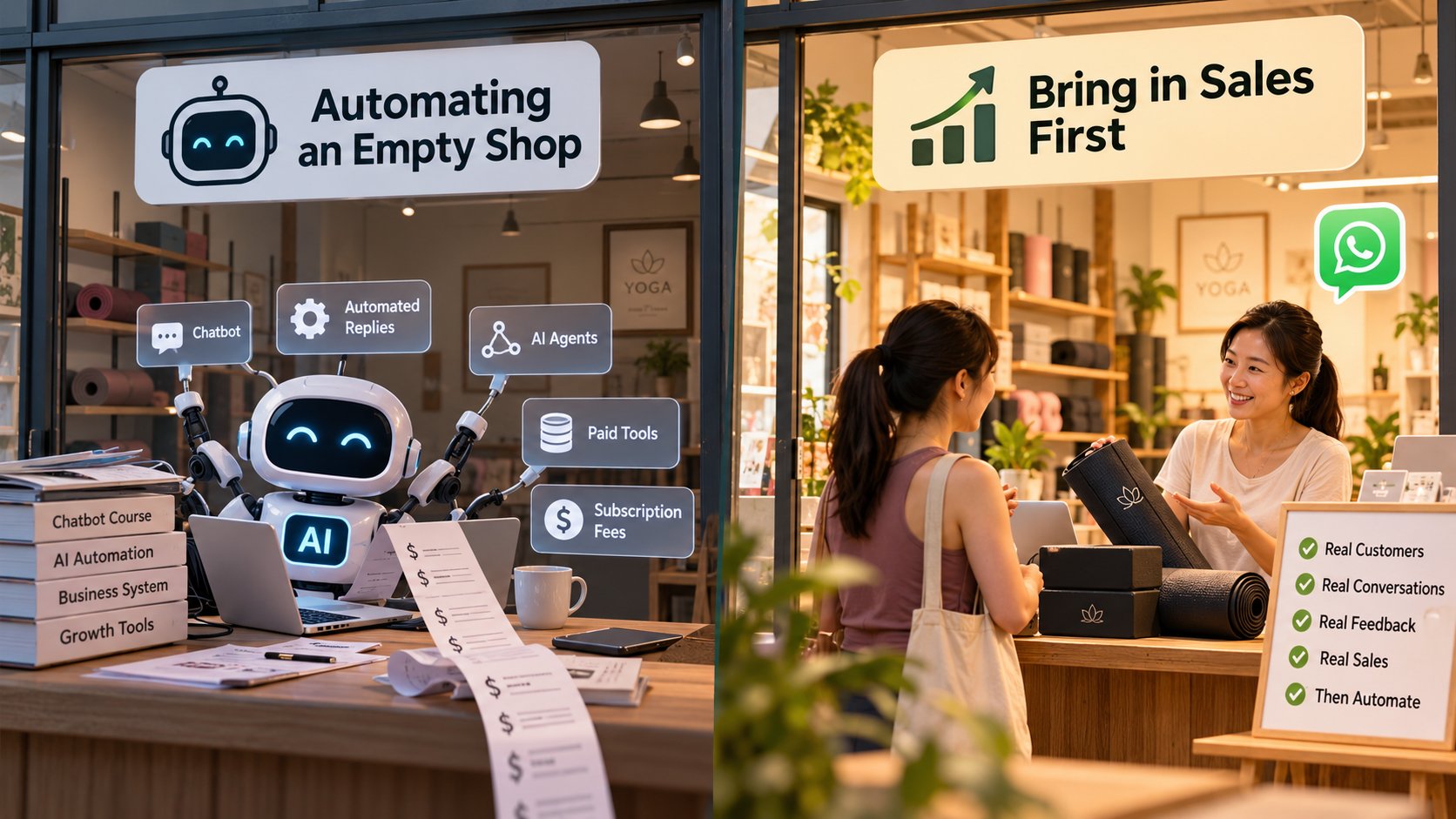
For a small business run by one person, don’t automate an empty shop. AI is most useful as a thinking partner, and automation can wait until there are sales worth automating.
These days my phone is full of videos and posts from experts and course sellers. Many of these posts seem to carry the same message: everything can be automated, and if you are not automating, you will not succeed. I will admit it made me nervous. Had I already fallen that far behind? Some days it felt like everyone else had an AI agent running their business while I was still replying to WhatsApp with two thumbs.
I learned this the slightly embarrassing way. After a Meta event I came home full of ideas about chatbots, AI agents and automated replies for Lexis Yoga. Then I looked at my order list. We had just received our first real customer order on the webstore! Rushing off to classes, or paying for a system, to serve one customer order would be like hiring a receptionist for an empty shop where nobody walks through the door. Paid tools and courses would add costs before I had the sales to justify them. My priority was to bring in sales first.
Lexis Yoga is run mostly by me. I do the sales and the marketing. What I needed first was a sounding board to help me plan how to bring in more sales and the cash to grow. AI could help with that. Sales had to be my focus.
Don’t automate an empty shop: it’s just a faster way to do nothing
Automation multiplies whatever is already there. Ten orders a day, automated, saves real hours. Zero orders a day, automated, is still zero, plus a monthly subscription fee. Basic automation is useful from day one. What can wait is the expensive system built for demand you have not yet earned.
For a one-person business, every hour spent wiring up a chatbot is an hour not spent with a customer, and customers are where the real learning happens.
Customers are real people, and people rarely say exactly what they want. The important signals are often unspoken: a pause when they hear the price, the question they ask twice, the product they keep picking up and putting down. You learn to read these signals through direct contact with customers, especially face to face. No AI tool can pick them up for you from a dashboard. AI can only work with what you bring back from those conversations.
This is also why, beyond a greeting and an away message, I handle WhatsApp enquiries personally for now. That lets me hear the exact words customers use and the doubts they have. Those words become the script for future quick replies, and later the training material for any automation. Automate too early and you automate guesses.
AI helps me prepare better, reflect on conversations and follow up faster. Building trust is still my job.
What I actually set up on WhatsApp, Facebook and Instagram
The Meta plan ended up much simpler than the one I dreamed about on the drive home. The goal was to make it easy for customers to reach me, and to answer them quickly with the right information.
- A WhatsApp button on Instagram, the Facebook page and lexisyoga.com, so every enquiry lands in one chat.
- The free WhatsApp Business app, with a product catalogue, a greeting message, an away message and a few quick replies for price, shipping and returns.
- Price questions answered with a photo, the price and the webstore link.
I looked at paid WhatsApp AI platforms and decided to wait for now.
One small lesson came from trying to let AI drive my browser to update the webstore. The AI was fast. The approval pop-ups were faster. I ended up clicking “Allow” more times than the AI clicked anything, and in the end I fixed the listings myself in ten minutes. Some jobs are simply quicker by hand, at least for now.
AI as my advisor, not my robot
The most valuable part of using AI was the conversations about strategy. In a bigger company I would talk ideas through with a sales manager, a marketing person and a finance colleague. As a one-man business I have none of them, so I talk it through with AI instead.
In practice, when I plan a new sales approach, I describe it to AI and ask it to poke holes in it. It points out risks I skipped, like a deal that would leave me holding unpaid stock. It also keeps asking how I will know whether a plan is working. That question led me to run a proper test: try the approach with 10 to 20 people over a month, with the success measures written down before I start. I will share the results in a later article.
It gets things wrong too. Some suggestions sound clever but do not fit how I want to do business, and a few were simply off. An advisor gives options. The owner still decides.
That is the role I value most: a patient sparring partner that helps one person think like a small team.
The catch: AI likes to agree with you
There is a real risk in brainstorming with AI. In my conversations, AI often agrees too readily, especially when my question hints at the answer I want. Ask “isn’t my new plan better?” and you will probably get a yes.
Talking to an advisor who mostly agrees with you is pleasant, and also a quick way to build an echo chamber. These are the habits I now use to keep it honest:
- Ask for the opposite case. “Argue against this plan” or “what would make this fail?” gives the AI permission to disagree.
- Keep my preferred answer to myself at first. I ask for the options before saying which one I like.
- Ask for numbers, not opinions. “What result after one month would prove me wrong?” is harder to flatter than “is this a good idea?”
- Get a second opinion in a fresh chat. A new conversation has not absorbed my views yet. I paste the plan and ask it to critique it like a sceptical investor.
- Let reality judge. Real orders and real rejections teach me more than any discussion.
- Keep real people in the loop. My partner, friends in business and my customers. AI adds to that circle. It does not replace it.
Used this way, AI is less of a yes-man and more of a sparring partner. I still make the call, and the market still grades the homework.
When to automate a small business with AI
I still plan to use automation and agentic tools, adding them in phases as sales justify the cost.
- Sell first. Talk to customers myself, with AI as my advisor for strategy, messages and content. The test is simple: are people buying?
- Make the repeatable things easy. As questions repeat, refine the quick replies, catalogue items and templates using what customers actually ask. This is still free.
- Automate what is proven. When enquiries outgrow what one person can answer, bring in a paid WhatsApp platform or chatbot, trained on the real conversations from phase one.
- Let agents run the routine. With steady sales, agentic tools can handle follow-ups, order updates, sales reports and content scheduling, while I focus on relationships.
The order matters more than the tools. A clever system built before the sales arrive mostly teaches you how to maintain a clever system.
If you are running a small business alone, my suggestion is this: don’t automate an empty shop. Use AI as the team you cannot afford yet. Ask it to challenge your ideas, check your numbers and help you write the message you are nervous to send. Then go out and make the sale yourself. The robots can wait. The customers should not.