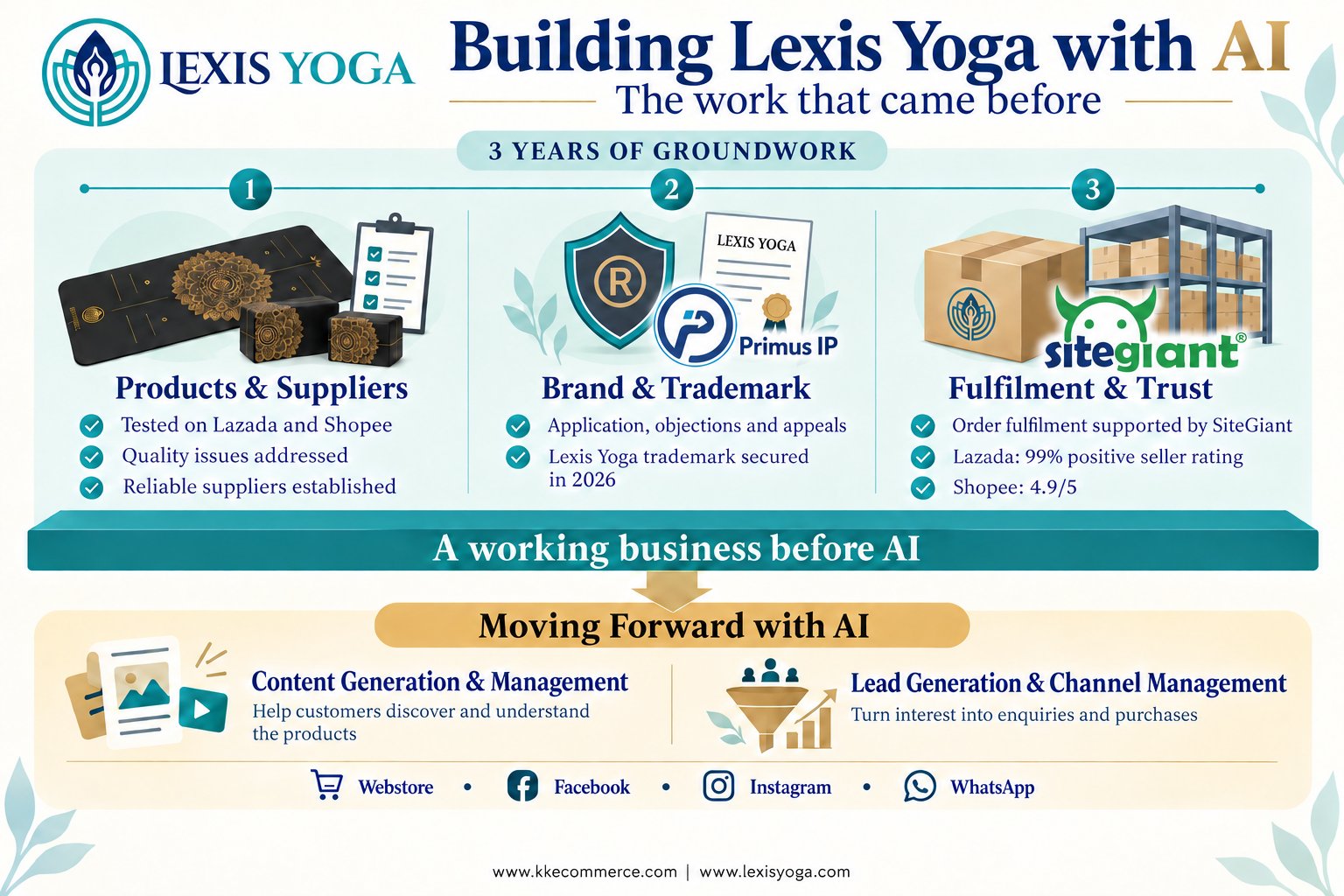
Before using AI to grow Lexis Yoga, we spent three years testing products, securing our trademark and building reliable order fulfilment. AI can help a small business do more, but it works best on a foundation that already exists.
Lexis Yoga is the business case I’m documenting on www.kkecommerce.com as I learn how to apply AI in a real business. My plan is to dedicate about four hours of my working day to learning AI tools and applying them to the brand’s content, marketing, planning and customer engagement. I’m focusing this experiment on growing the brand, with our existing fulfilment operation supporting the orders.
I want to see how much more one person can achieve with AI while keeping the business lean. Over time, I hope to build the capacity of a small team without taking on the overheads of hiring one from day one, while turning Lexis Yoga into a competitive wellness brand.
Before going further, though, I need to make something clear. I’m starting this AI journey with a business that already has a foundation. It would give the wrong impression if I made it sound as though anyone could simply pick a product, add AI and expect a business to follow.
Three years of testing Lexis Yoga products and suppliers
I started selling Lexis Yoga products on Lazada about three years ago and later expanded to Shopee. Those marketplaces gave us a demanding environment to test our products, suppliers and service in. Customers paid with their own money, used the products, and told us exactly what they thought.
When products had quality issues, we withdrew them and refunded affected customers promptly, without arguing over the problem. Products that performed well were gradually customised under the Lexis Yoga brand. By the time I began exploring AI for the business, we already had suppliers we could work with and products we had confidence in.
The Lexis Yoga trademark journey that nearly made me give up
Getting the Lexis Yoga trademark was one of the most frustrating parts of this journey. We faced objections concerning the name’s similarity to Lexus and the use of “Yoga” as a common term. At certain points, I seriously considered giving up.
We eventually changed our trademark service provider and approached Primus IP. Looking back, that was one of the most useful decisions I made. They took the time to understand our situation and worked through the available options with us.
While the application and appeals continued, we maintained a modest presence on Lazada, Shopee, Amazon Singapore and Amazon Australia. We kept the business going and kept building a record of the brand’s use. After about three years of effort, our appeal succeeded and we obtained the Lexis Yoga trademark in 2026. I’m especially grateful to Ashley Chiew and the team at Primus IP for helping us through it.
The operations behind every order
During that time, we also built up our fulfilment capability with SiteGiant, a Malaysian solutions provider that has supported my e-commerce journey for about ten years. Their system connects our sales channels and manages orders more efficiently, giving us the operational backbone to pack and dispatch purchases consistently.
Our LazMall store has achieved a 99% positive seller rating, and our Shopee store sits at 4.9 out of 5. These results took time, reliable products and consistent service to earn. They’re part of the foundation I’m bringing into this AI experiment.
What AI can build on
AI can help me write, plan, analyse and get more done, but it can’t turn a mediocre product into something customers come back for, and it can’t make up for a late order or a problem nobody bothered to fix.
For anyone starting a retail business, my advice is to begin with products and suppliers you can trust. Work out how you’ll fulfil orders reliably, whether through your own operation or a third party. And give your brand name and trademark plans attention early. Ours took three years, so don’t assume it will be quick.
The next test: growing beyond the marketplaces
Our next step is to grow Lexis Yoga beyond the marketplaces, through channels where customers can get to know the brand and reach us directly. We’ve launched our webstore, www.lexisyoga.com, on the SiteGiant platform, alongside our Facebook page and Instagram account. We also have a dedicated Lexis Yoga WhatsApp number, linked from the webstore and our social media profiles, so customers have one place to reach us. I shared more about this setup, and why I’m keeping it simple for now, in Don’t Automate an Empty Shop with AI.
With these channels in place, our immediate objective is to use AI to help bring in more customers and sales. I’ve started two projects: Content Generation and Management, to help people discover our products and understand why they might choose them, and Lead Generation and Channel Management, to turn that interest into enquiries and purchases. I’m still working through the ideas with AI, questioning its suggestions and deciding what to test first. I’ll share our progress on www.kkecommerce.com, including what we try, the results we see, and what still needs fixing.
Three years of groundwork brought Lexis Yoga to this point. Now comes a different test: how far four hours a day and AI can take the brand. I have plenty of ideas, but ideas are the easy part. The next chapter will be measured by whether customers choose our products, come back, and recommend us to someone else. That’s the part I’m working on now, and the story I’ll keep sharing here.